Black parts that
stay black.
No dyeing. No white core. No colour layer wear after 6 months. PA 950 HD delivers consistent industrial black, straight from the printer.
Comparable mechanical properties to PA12 (47 MPa), 80% powder reusability, approximately 35% lower cost per part. Smoother surface, finer details, and better tolerances than dyed PA12 or MJF. The only industrial-black PA12-class SLS polyamide in Europe, exclusively available at Parts on Demand.
What is the problem with black SLS parts?
Most 3D printing bureaus deliver black as a dyeing step. That is not a colour, that is a coating with an expiration date.
White core showing through wear
Standard PA12 is white. Dyeing sits only on the surface. Every scratch, chip, or wear spot reveals the white core underneath.
Colour variation between batches
Dyeing processes are inherently variable. Batch 1 and batch 50 rarely look identical. For appearance parts in series, that is a problem.
Additional cost and lead time
Dyeing adds 15-25% in cost and 1-3 business days in lead time. In series production, that adds up quickly.
MJF: grey, not black
HP Multi Jet Fusion parts are grey on the outside with orange peel texture on thick walls. Not an alternative for consistent black.
What is PA 950 HD and how does it solve the colour problem?
PA 950 HD uses pigment distributed throughout every powder particle. Not on the surface, but through the core. Produced on EOS P500 dual-laser systems. The result: parts that look identical on day 1 and day 1,000.
Standard lead time: 3 to 5 business days. No dyeing step adding 1 to 3 days, no extra logistics. You receive black parts faster than your competitors receive dyed parts.
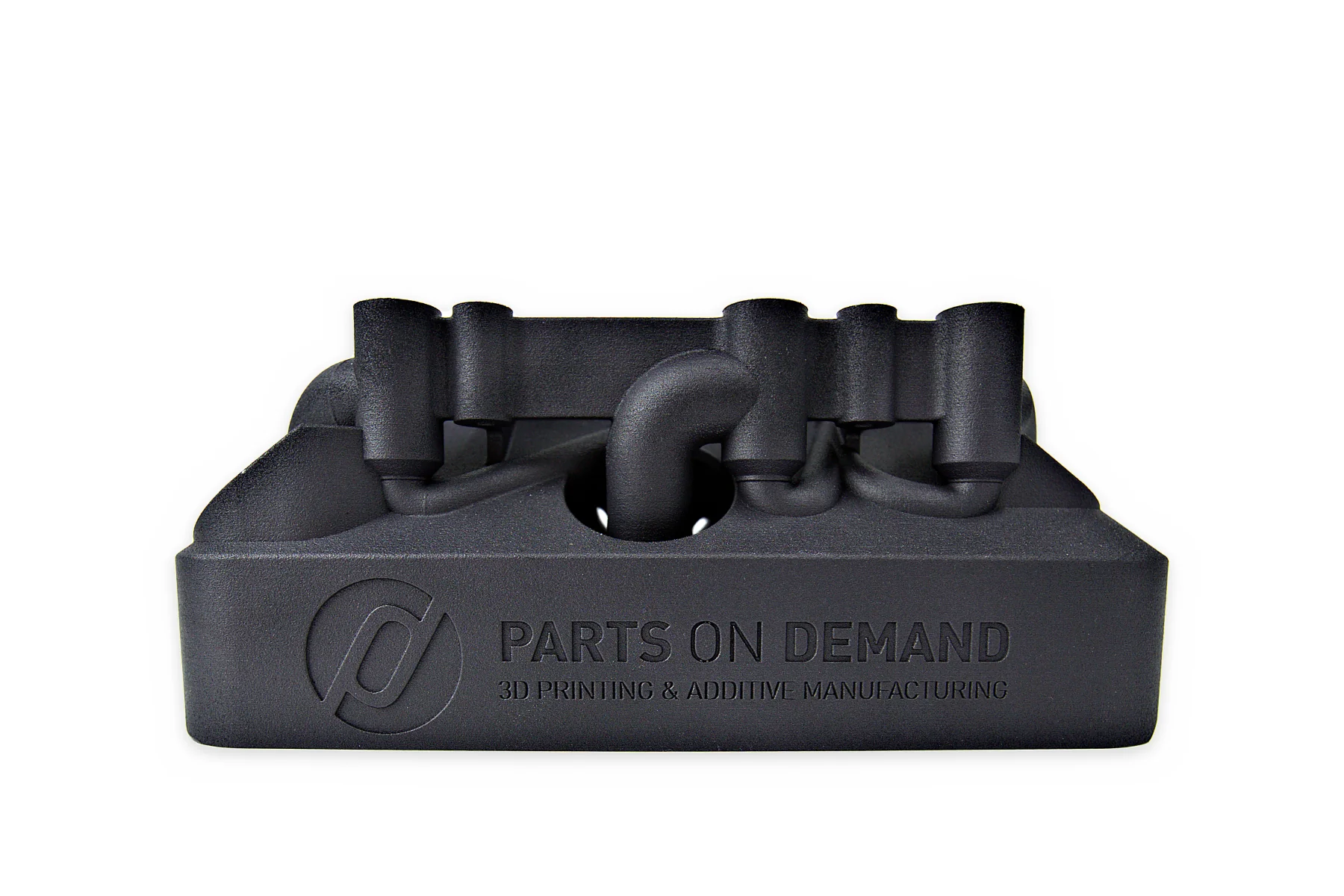
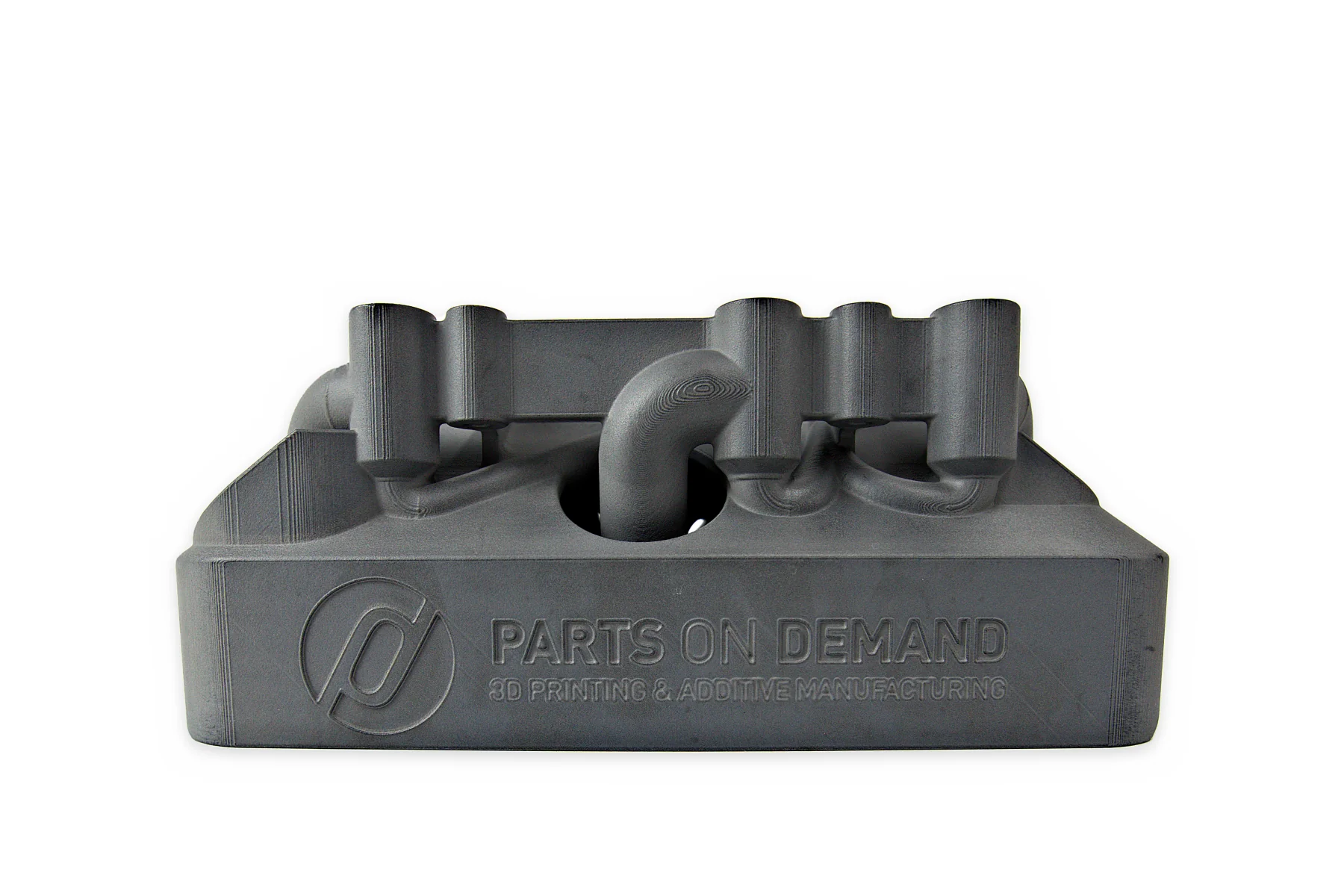
| Criterion | PA 950 HD | Dyed PA12 | MJF (PA12) |
|---|---|---|---|
| Colour cross-section | Fully black | White core | Grey |
| Post-processing required | No | Yes (dyeing) | Yes (dyeing for black) |
| Colour wear resistance | Permanent | White core visible after wear | Grey visible after wear |
| Batch consistency | High | Variable (dyeing process) | Variable (orange peel) |
| Surface quality | Smoother (smaller particle size) | Depends on dyeing process | Rougher (detailing agent, larger powder) |
| Detail resolution | Finer (smaller powder particles) | Same as base PA12 | Limited on fine features |
| Tolerances and reproducibility | Near-CNC (closed-loop P500) | Variable (dyeing step distorts) | Variable with changing nesting |
| Additional cost | None | +15-25% | +10-20% |
| Additional lead time | None | +1-3 business days | +1-2 business days |
Not just black. Also smoother, sharper, and more precise.
PA 950 HD has a smaller particle size distribution than standard PA12 and MJF powders. That sounds like a technical detail, but you notice it in three things that matter in production.
Smoother surface without post-processing
Smaller powder particles fuse more closely together. The result is a visibly smoother surface, straight from the machine. No blasting, no polishing, no extra cost. Your parts are directly suitable as appearance parts.
Sharper details and finer features
Thin walls, small holes, fine text, and sharp edges come out better than with standard PA12 or MJF. If your design has fine features, you need to make fewer compromises on manufacturability.
Tighter tolerances, higher reproducibility
Closed-loop process control on the EOS P500 delivers near-CNC dimensional tolerances. Part 1 and part 10,000 are identical. No tolerance drift when scaling up, no revalidation needed when moving from prototype to series.
The smaller particle size distribution of PA 950 HD is documented in the ALM technical specification (2026). Surface quality and detail resolution depend on orientation and wall thickness.
What are the technical specifications of PA 950 HD?
Every number below is verifiable. No marketing claims, but test data from ALM and EOS.
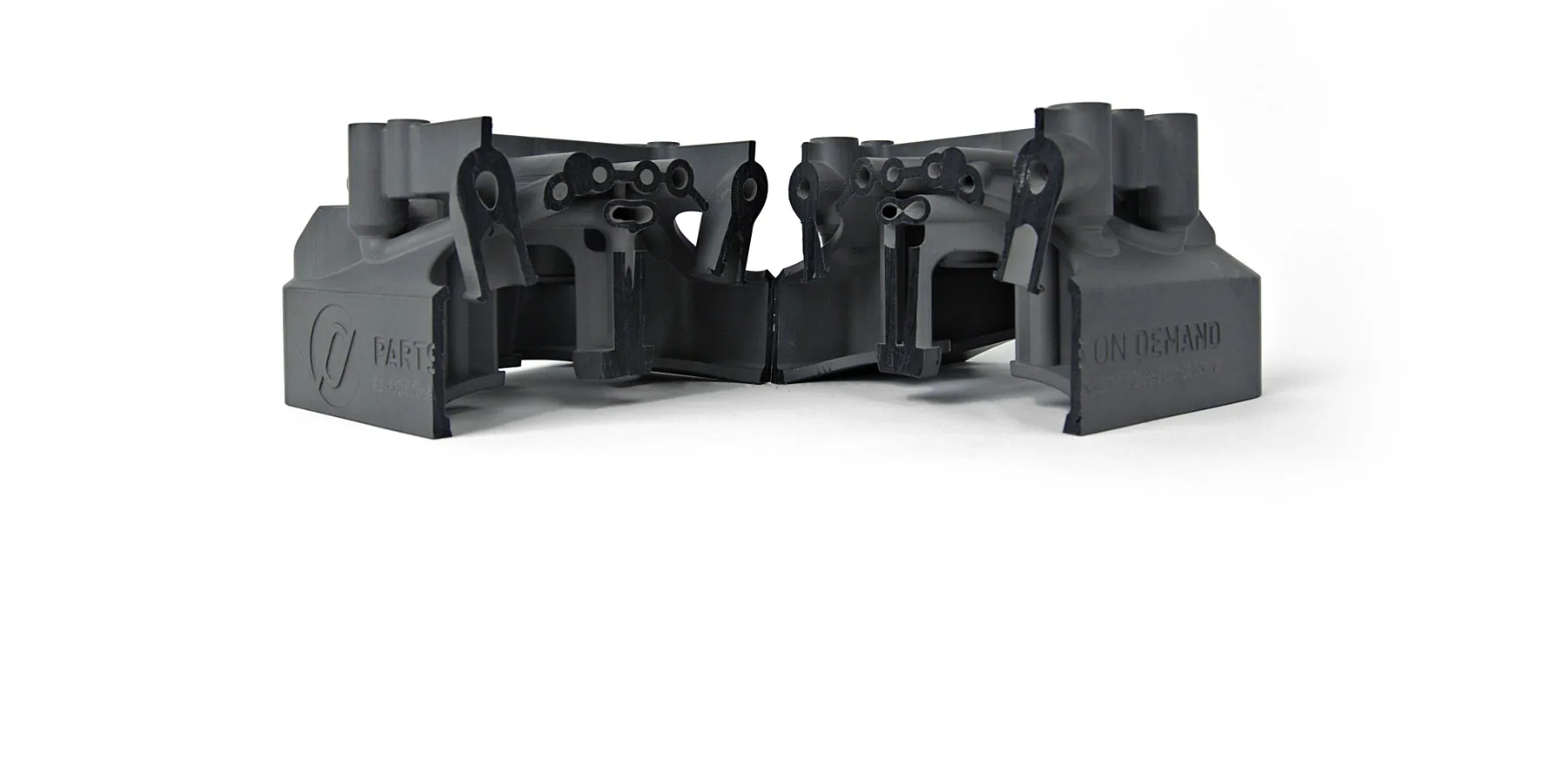
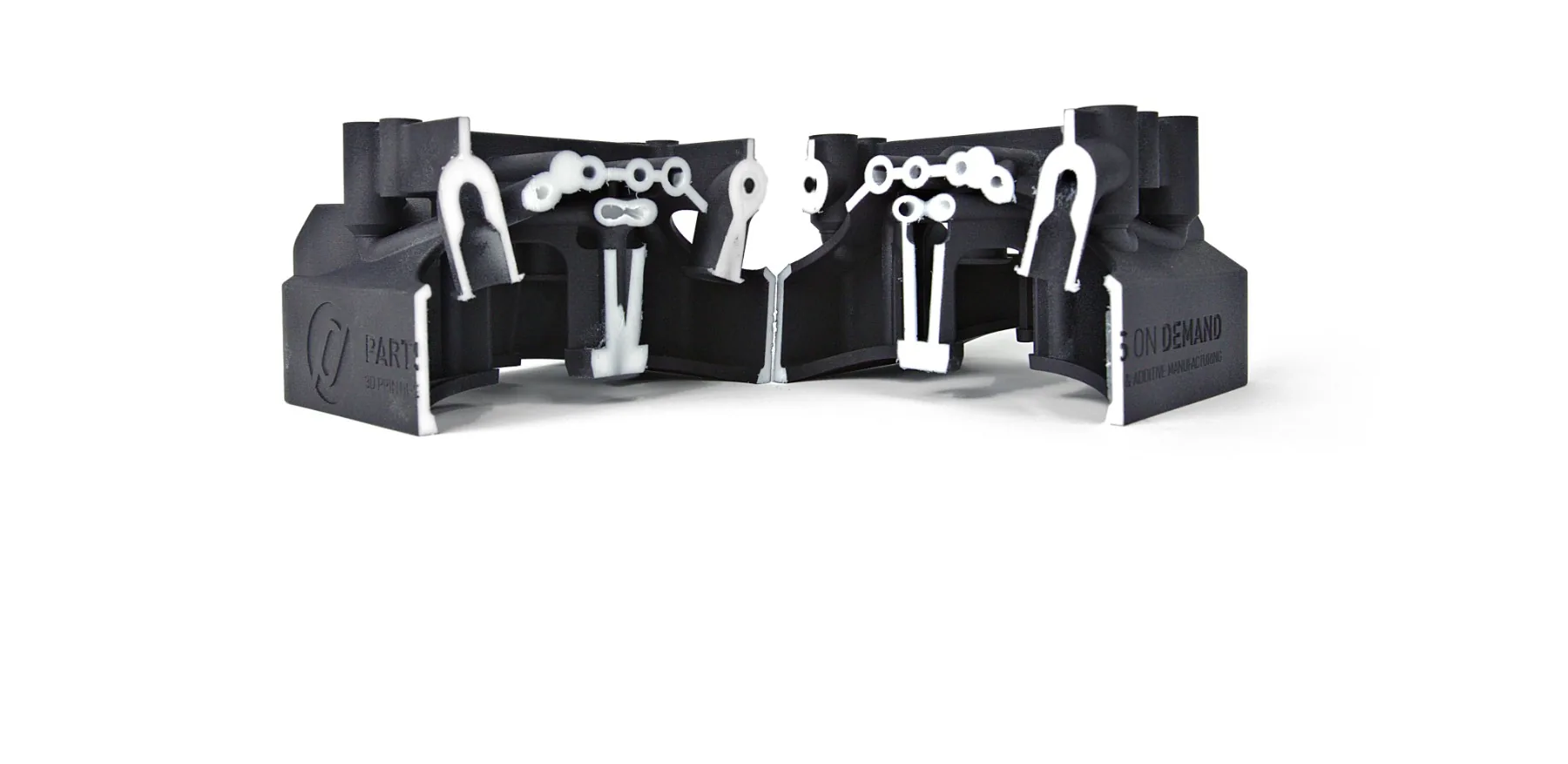
Tensile strength: 47 MPa (ALM PA 950 HD technical data sheet, 2026). Comparable to standard PA12 (48 MPa). The 4 MPa difference is negligible for most industrial applications.
E-modulus: 1800 MPa. Slightly higher than PA12 (1700 MPa), resulting in marginally stiffer parts.
Elongation at break: 18%. Sufficient ductility for snap-fits, living hinges, and parts that need to withstand elastic deformation.
Powder reusability: 80% (ALM technical specification, 2026). Standard PA12 achieves ~50%. This difference translates directly to lower material costs. Unused powder goes back into the next build without mechanical properties changing. You pay less per part and get the same part, batch after batch.
Traceability: full build documentation. Every PA 950 HD build is traceable via the CO-AM platform. Material batch, laser parameters, build chamber temperature, and quality control, documented per order. For customers with audit requirements, that is the difference between trust and proof.
From machine housing to medical device. PA 950 HD has been tested to ISO 10993-5 and is non-cytotoxic. That opens up applications where parts are in daily contact with skin: tool grips and handles, wearable electronics, orthoses and prosthetic covers, and housings for medical, diagnostic and laboratory equipment. That is exactly where colour through the whole material counts: no dye layer that rubs off on hands or wears away during cleaning. Developing a medical device? The test report is available on request for your technical file.
What does PA 950 HD cost compared to dyed PA12?
80% powder reusability leads to 35% lower cost per part. In series production, that is the difference between a viable and an unaffordable business case.
(ALM technical specification, 2026)
(PoD internal production data, 2026)
Cost calculation based on ALM technical specification (2026) and PoD internal production data. Reference: dyed PA12 at equivalent volumes.
Frequently asked questions
What is PA 950 HD?
PA 950 HD is an industrial-black PA12-class SLS polymer, co-developed by ALM and EOS. The material is black to the core, without dyeing or post-processing. 47 MPa tensile strength, 80% powder reusability, approximately 35% lower cost per part compared to dyed PA12.
Why is industrial black better than dyed PA12?
Dyed PA12 has a white core. With wear, chips, or scratches, that white core becomes visible. PA 950 HD is black throughout the entire material. Dyeing itself costs extra time (1-3 business days), money (15-25% surcharge), and introduces risk of colour variation between batches.
How does PA 950 HD compare to MJF black?
MJF parts (HP Multi Jet Fusion) are grey on the outside and show orange peel texture on thick walls. PA 950 HD delivers a smoother, consistent black surface thanks to the smaller particle size distribution. Finer details and sharper features come out better. Combined with closed-loop process control on the EOS P500, you get better tolerances and reproducibility.
Does PA 950 HD have a better surface than standard PA12 or MJF?
Yes. PA 950 HD has a smaller particle size distribution than standard PA12 and MJF powders. This delivers a smoother surface, sharper details, and finer features, straight from the machine. Combined with closed-loop process control on the EOS P500, this results in near-CNC tolerances and high reproducibility in series production.
Is PA 950 HD suitable for food-contact applications?
PA 950 HD is currently not certified for food contact (EC1935/2004 or FDA). For food-contact applications, Parts on Demand offers PA12 on the EOS P500. Contact us to discuss the specific requirements of your application.
Can I have PA 950 HD produced elsewhere in Europe?
Not at this time. Parts on Demand is the only European production partner with the PA 950 HD + EOS P500 combination operational.
Explore further
Test PA 950 HD with your design
Upload your STEP file and receive a quote within seconds. No account needed.