EOS P500 dual-laser SLS
Part 1 and part 50,000 are dimensionally identical. Lead time: days, not weeks. And when your series grows from 100 to 10,000 parts, you change nothing in the production process. The EOS P500 delivers the precision you expect from machining, with the lead time and scalability that make moulds redundant.
Last updated: September 2026
What is the EOS P500 and why does it matter?
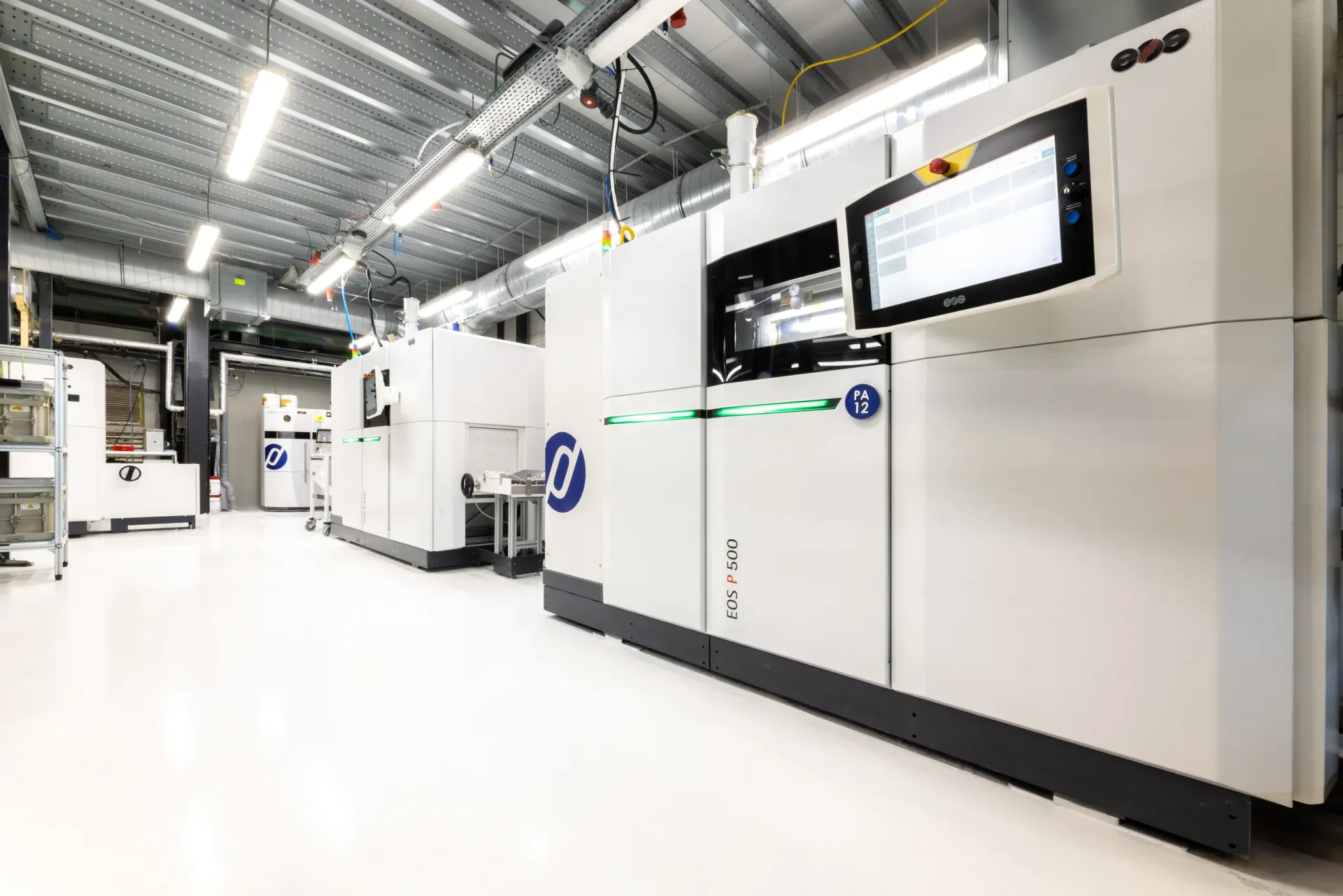
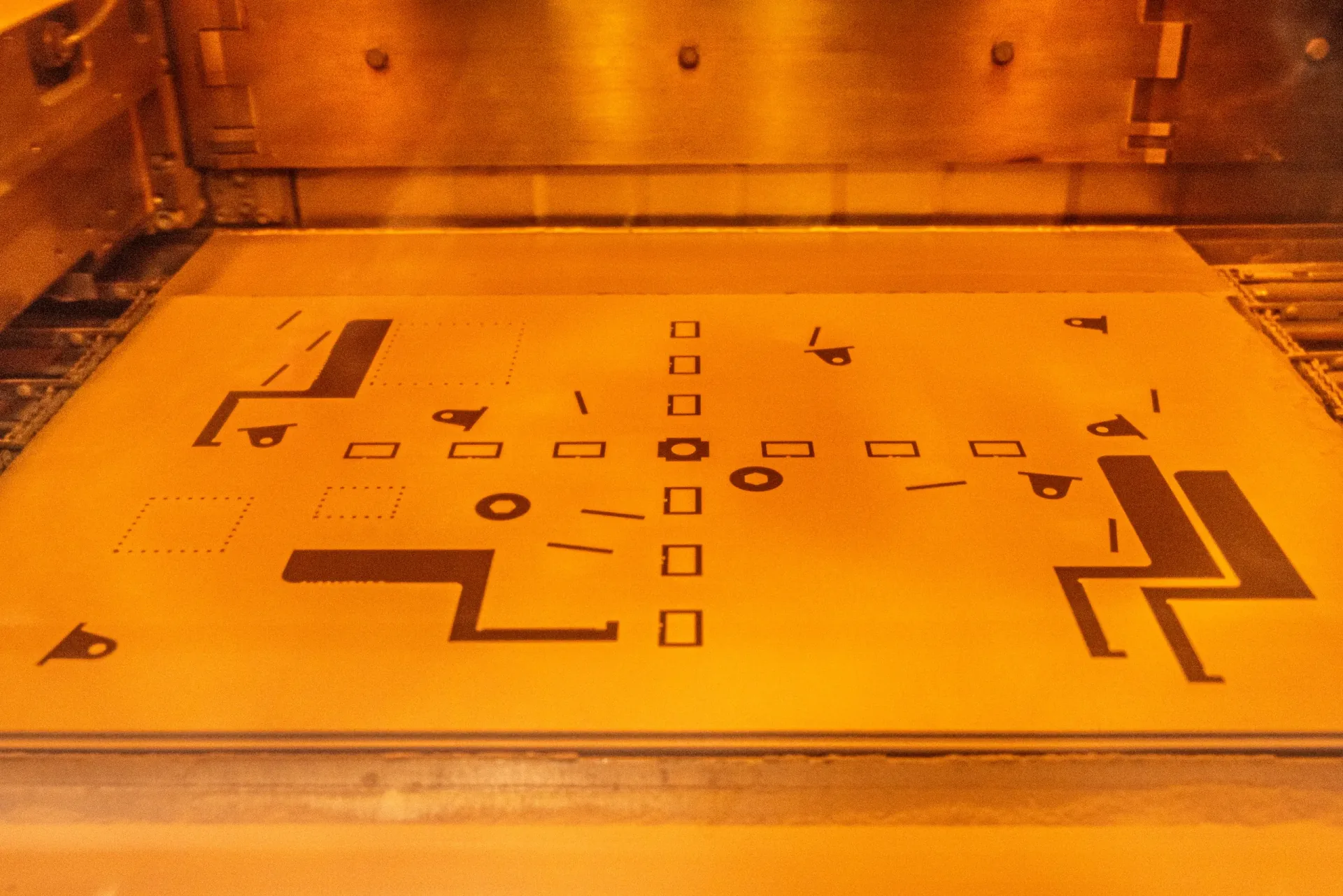
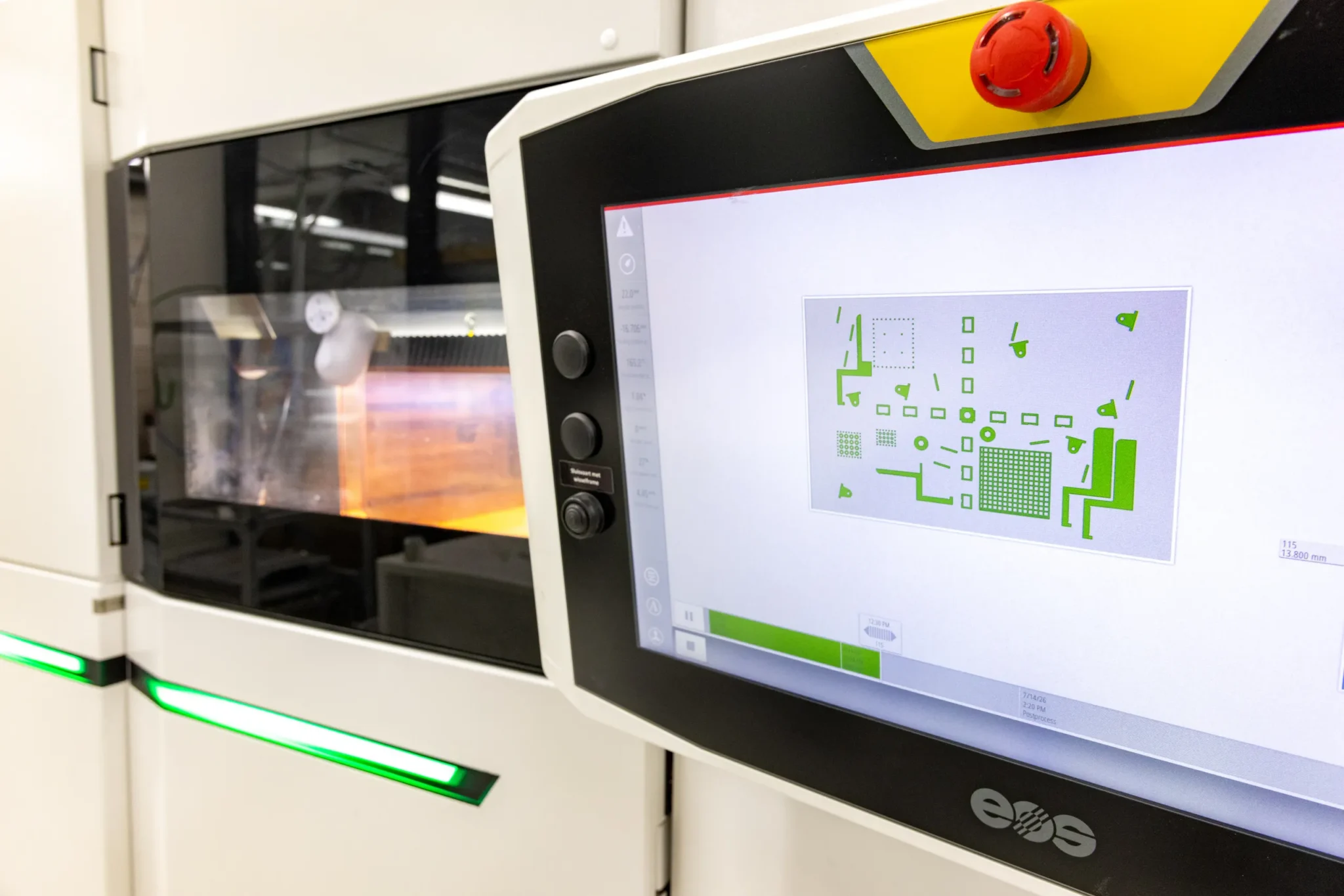
The EOS P500 is a dual-laser SLS (Selective Laser Sintering) production system from EOS GmbH, designed for industrial series production of polymer parts. The system combines two CO2 lasers with closed-loop process control that monitors and adjusts temperature, laser energy, and layer thickness in real time. According to the EOS product specification, this delivers near-CNC dimensional tolerances, build after build.
If you need functional parts with tight tolerances today, CNC milling is often the answer. But CNC scales poorly: every part costs the same machine hours, whether you need 10 or 10,000. Injection moulding scales well, but requires moulds, weeks of lead time, and minimum order quantities of thousands. The EOS P500 sits precisely in between: series of 5,000 to 50,000 parts on lead times of days rather than months, with near-CNC tolerances and zero tooling costs.
No need to revalidate when moving from prototype to series. Closed-loop process control delivers near-CNC dimensional tolerances, build after build. No parameter drift, no surprises at incoming inspection.
Your series of 5,000 parts runs in days, not the 8 to 16 weeks you spend on a mould trajectory. No tooling costs, no minimum order quantity, and if your design changes tomorrow, the next batch runs with the new file.
Start with 10 parts for validation and scale to 50,000 without switching machines, materials, or process parameters. What you approve in testing is what your customer receives in production.
Your parts do not need sanding, polishing, or vapour smoothing. The surface is directly suitable as an appearance part. That saves you a process step, a supplier, and 2 to 5 days of lead time.
How does the EOS P500 achieve CNC accuracy from an SLS printer?
The P500 continuously measures and adjusts: temperature in the build chamber, energy per laser pulse, thickness of every powder layer. If a parameter deviates, the machine corrects automatically before it affects your part. That closed-loop control is what makes near-CNC dimensional tolerances possible in an additive process.
In practice: part 1 and part 50,000 are dimensionally identical. No parameter drift, no surprises at incoming inspection, no revalidation cycles. If you deliver parts to customers who expect measurement reports and Cpk values, that is the difference between a 3D print that is “good enough” and one that gets approved.
EOS P500 vs CNC vs injection moulding
| Criterion | EOS P500 (Parts on Demand) | CNC milling | Injection moulding |
|---|---|---|---|
| Dimensional tolerances | Near-CNC (closed-loop) | Reference (high) | High (with good mould) |
| Tooling costs | None | None (but fixtures) | High (moulds) |
| Lead time first parts | 3-5 business days | 1-2 weeks | 8-16 weeks (incl. mould) |
| Cost at 10 parts | Low | High (per part) | Not feasible |
| Cost at 10,000 parts | Competitive | Very high | Lowest per part |
| Geometric freedom | Unlimited (no tooling) | Limited (cutter access) | Limited (draft angles) |
| Minimum order quantity | 1 part | 1 part | Thousands (mould ROI) |
| Design change | Instant (upload new file) | New program | New mould (weeks + cost) |
| Build-to-build consistency | Identical (closed-loop) | High (machined) | High (stable process) |
Comparison based on EOS P500 system specification (2025) and Parts on Demand internal production data (2026). The P500 does not replace CNC and injection moulding in all cases. Where it works: functional parts in series of 100-50,000, complex geometries, and situations where lead time or tooling costs cannot be justified.
Which materials run on the EOS P500?
Every material we run on the P500 is validated with fixed process parameters (per EOS material qualification protocol). You do not get "a material on a machine", but a tested combination with known mechanical properties and reproducible results.
PA 950 HD
Industrial black, black to the core. 47 MPa tensile strength, 80% powder reusability. No dyeing required.
PA12 (white)
The industry standard for functional SLS parts. 48 MPa tensile strength, broadly applicable.
Custom materials (EOS P396)
PA640GSL (Carbon LW) and PA802CF run on our seven P396 production lines. Specialised materials via our EOS/ALM Custom Development Partnership.
How does the EOS P500 scale from prototype to series production?
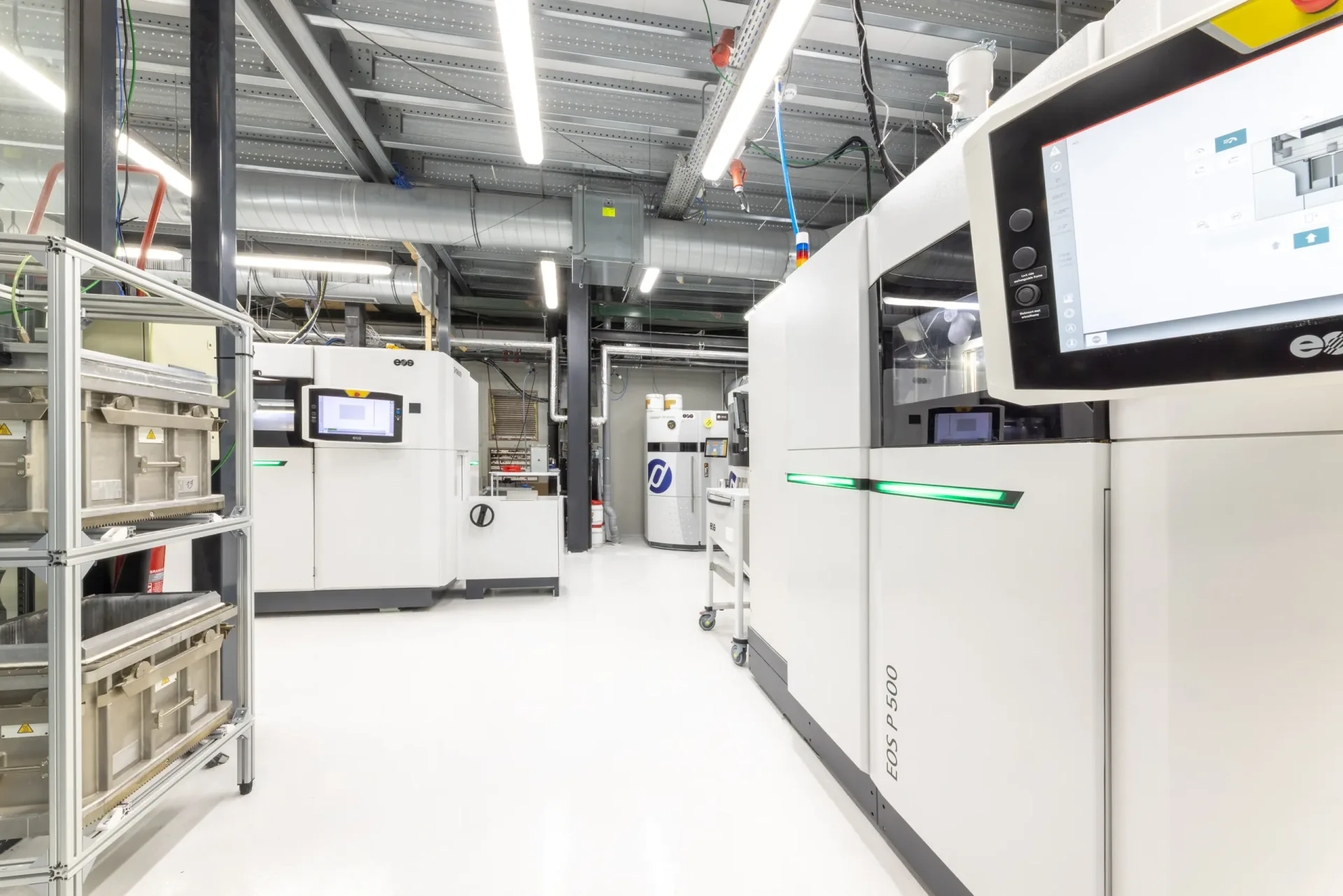
Most scaling problems in 3D printing come not from the material, but from the process. Different machine, different facility, different parameters. At Parts on Demand, everything runs on the same three P500 systems. You start with a prototype of 10 parts, validate, and scale to 10,000 without changing anything in the production process.
That saves you more than revalidation time. It eliminates the risk that your series parts turn out slightly different from your prototype. What you approve in testing is what your customer receives in production.
How much capacity does the EOS P500 deliver at Parts on Demand?
When your series grows from 100 to 10,000 parts, you do not want to switch suppliers or wait for a free machine slot. Production capacity at Parts on Demand is designed for that scaling: three identically configured P500 systems run in parallel, supported by seven P396 production lines. According to the EOS P500 system specification, the dual-laser configuration delivers 3-4x higher throughput per machine compared to conventional SLS.
In practice: for parts in the range of 100 to 50,000 units, where geometry is too complex for milling or mould costs cannot be justified, the P500 is the alternative that delivers both precision and volume. No tooling costs, no minimum order quantity, and the same quality on part 1 as on part 50,000.
Frequently asked questions about the EOS P500
How do P500 tolerances compare to CNC milling?
The P500 delivers near-CNC dimensional tolerances thanks to closed-loop process control. For most functional parts, dimensional results are comparable to machining, but without the geometric limitations and setup costs of milling. For parts where micron-level accuracy is required, CNC remains the better choice.
Can the P500 replace injection moulding?
In specific cases, yes. For series of 100 to 50,000 parts, complex geometries, and situations where mould costs or lead time cannot be justified, the P500 delivers comparable output at a fraction of the lead time. You save 8-16 weeks of mould development and can start immediately. At volumes above 100,000 or very simple geometries, injection moulding is generally more cost-effective.
How large can my parts be?
The build volume is 500 x 330 x 400 mm. That accommodates most industrial parts. For smaller parts, multiple units are nested in a build job, which reduces cost per part.
Which materials run on the P500?
The EOS P500 runs PA 950 HD (industrial black) and PA12 (white), each validated with fixed process parameters. Additionally, Parts on Demand delivers PA640GSL (Carbon LW) and PA802CF on the EOS P396 production lines via our EOS/ALM Custom Development Partnership.
What if my volumes grow?
Parts on Demand runs three EOS P500 systems with identical configuration. Your prototype and your series of 50,000 parts run on the same machines with the same parameters. Scaling up requires no revalidation and no supplier switch.
Can I visit the P500 production facility?
Yes. Our facility in Utrecht is open for visits. You can see the three P500 systems and seven P396 lines running, examine material samples, and talk to our engineers about your application. Schedule a visit.
Explore further
Curious what the P500 means for your parts?
Upload your STEP file and receive a quote within seconds. Your parts run on the EOS P500.
Talk to an engineer